Halal Certification in the USA
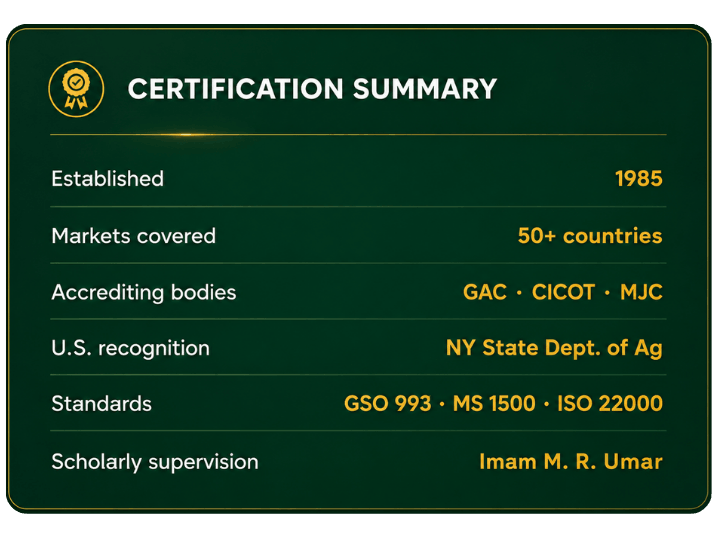
Halal Watch has provided accredited halal certification to U.S. businesses since 1985 — longer than any other active halal certifier in the country. Our certificates are recognized by the GCC Accreditation Center (GAC), the Central Islamic Council of Thailand (CICOT), the Muslim Judicial Council of South Africa (MJC), and the New York State Department of Agriculture, making them accepted in 190+ regulated halal import markets worldwide.
Whether you are a food manufacturer seeking retail shelf space, a restaurant serving a Muslim community, or an exporter targeting GCC or Southeast Asian markets, halal certification in the USA from Halal Watch gives you a single accredited certificate accepted across all of them.
Recognized By
- GCC Accreditation Center
- CICOT — Thailand
- Muslim Judicial Council — South Africa
- NY Dept. of Agriculture
What Is Halal Certification?
Halal certification is a formal, third-party verification process confirming that a product, ingredient, facility, or supply chain complies with Islamic dietary law (Shariah). The Arabic word “halal” means permissible — and for a product to legally carry a halal certificate in regulated markets, it must be verified by an accredited certifier, not simply self-declared by the manufacturer.
The certification process covers four core areas:
01
Ingredients & Formulas
Every ingredient, additive, processing aid, flavoring, and packaging material is reviewed against halal standards. The most common failure points are hidden haram sources — pork-derived gelatin, animal-based enzymes, alcohol carriers in flavorings, and non-halal slaughter by-products used as processing aids.
02
Facility & Equipment
Every ingredient, additive, processing aid, flavoring, and packaging material is reviewed against halal standards. The most common failure points are hidden haram sources — pork-derived gelatin, animal-based enzymes, alcohol carriers in flavorings, and non-halal slaughter by-products used as processing aids.
03
Slaughter & Handling
Every ingredient, additive, processing aid, flavoring, and packaging material is reviewed against halal standards. The most common failure points are hidden haram sources — pork-derived gelatin, animal-based enzymes, alcohol carriers in flavorings, and non-halal slaughter by-products used as processing aids.
04
Ongoing Compliance
Every ingredient, additive, processing aid, flavoring, and packaging material is reviewed against halal standards. The most common failure points are hidden haram sources — pork-derived gelatin, animal-based enzymes, alcohol carriers in flavorings, and non-halal slaughter by-products used as processing aids.
For a complete explanation of what each compliance area involves — including the ingredient categories most commonly found to be non-halal during audits — see our full halal certification requirements guide.
Size, Growth, and Opportunity
The United States halal food and beverage market is one of the fastest-growing specialty food segments in the country. Key figures:
The domestic Muslim consumer base is concentrated in New York, New Jersey, Michigan, Illinois, California, and Texas — but halal purchasing behavior extends well beyond these hubs as online retail and halal-certified mainstream grocery products expand nationally.
Equally important: a significant share of U.S. halal product demand comes from non-Muslim consumers who associate halal certification with cleaner ingredients, humane handling, and stricter quality oversight. Major retail chains including Walmart, Whole Foods, Costco, and Kroger have expanded halal-certified product ranges in response to this dual demand.
Which Markets Require It
Over 190+ countries maintain regulated halal import requirements. U.S. exporters cannot legally sell food, beverage, cosmetic, or pharmaceutical products into these markets without a halal certificate issued by a certifier recognized by the importing country’s halal authority. Self-declaration or unaccredited certificates are rejected at customs.
Gulf Cooperation Council (GCC)
GAC RECOGNIZED — ALL 6 STATES
Saudi Arabia, UAE, Qatar, Kuwait, Bahrain, and Oman require halal certificates from certifiers recognized by the GCC Accreditation Center (GAC). Halal Watch holds GAC recognition — meaning our certificates satisfy import registration requirements across all six GCC member states without secondary endorsement.
Malaysia & Southeast Asia
MS 1500 · CICOT
Malaysia requires JAKIM-recognized certification for regulated product categories. Indonesia (the world’s largest Muslim-majority country) requires MUI recognition for food imports. Halal Watch’s alignment with MS 1500 and CICOT recognition supports market access across Malaysia, Thailand, Singapore, and Brunei.
Southern Africa
MJC RECOGNIZED
South Africa’s halal import market is governed by the Muslim Judicial Council (MJC). Halal Watch holds MJC recognition, supporting exporters targeting the South African retail and food service market.
United Kingdom & Europe
UK / EU ACCEPTED
Post-Brexit UK halal standards and EU member state halal import policies vary by product category and importing retailer. Halal Watch certificates are accepted by major UK and European halal importers and retailers operating under recognized accreditation frameworks.
View our full international halal accreditation and recognition page for the complete market-by-market breakdown of which accreditation applies and what each requires.
Which Standard Applies to You
The halal standard applied to your certification determines which markets will accept your certificate. Halal Watch certifies against the following internationally recognized standards:
Gulf Cooperation Council halal food standard. Mandatory for GCC market access. Covers food, beverage, slaughter, processing, packaging, and labeling.
Malaysian national halal standard. Referenced across Southeast Asian import markets. Covers general food and food ingredient halal requirements.
Emirates Authority for Standardization halal standard for cosmetics, personal care, and pharmaceutical products. Required for UAE non-food halal product registration.
Halal Industry Production Standards — U.S. domestic halal production standard governing restaurant operations, food service, and retail halal programs.
Food safety management standard integrated with halal compliance for manufacturers supplying institutional buyers and retail chains with combined halal and food safety requirements.
To understand which standard applies to your specific product type and target market, see our halal certification requirements overview or start your free needs assessment — our team identifies the applicable standard as part of the proposal process.
Halal Watch’s multi-standard audit approach means a single certification engagement can produce a certificate valid across multiple standards and markets — reducing audit fatigue and cost for businesses with multi-market distribution.
Six Stages to Certification
1. Free Needs Assessment
Submit your product list, ingredient overview, facility details and target markets. Receive a no-obligation proposal within 24–48 hours.
2. Application & Documentation
Review the full list of required documents on our halal certification documentation requirements page before submitting.
3. Ingredient & Formula Review
Every ingredient reviewed under the supervision of Imam Mansoor Rafiq Umar. You receive a detailed status report before any site visit.
4. Facility Inspection
Before your inspection, review our halal audit preparation requirements to confirm your facility is ready.
5. Certificate Issuance
Issued digitally with a unique verification number and listed in the public Halal Watch certification directory.
6. Ongoing Compliance
Annual surveillance audits and pre-approval of ingredient or formula changes maintain certificate validity.
How Much Does Halal Certification Cost in the USA?
Halal certification cost in the USA ranges from $3,000 to $70,000+ annually depending on business type, number of products, facility complexity, and target markets.
Restaurants
$3K–$8K /yr
Small manufacturers (1–10 SKUs)
$5K–$15K /yr
Mid-size manufacturers (10–50 SKUs)
$15K–$35K /yr
Large multi-facility operations
$35K–$70K+ /yr
These are indicative ranges. Your exact cost depends on facility size, number of SKUs, industry risk category, and target markets. Our halal certification cost guide covers all four pricing models (fixed fee, poundage-based, percentage of sales, and hybrid) with a full breakdown by industry. Alternatively, complete the free needs assessment and receive an itemized proposal within 24 hours.
Industries We Certify
Packaged foods, snacks, beverages, dairy, bakery, confectionery
Slaughterhouses, processing plants, cold storage, and distribution
Full-service restaurants, fast casual, catering, ghost kitchens
Packaged foods, snacks, beverages, dairy, bakery, confectionery
Slaughterhouses, processing plants, cold storage, and distribution
Full-service restaurants, fast casual, catering, ghost kitchens
View all industries and certification scope on our halal certification services page, or see our halal certification for restaurants and halal meat certification pages for the most complex certification categories.
Frequently Asked Questions
Is halal certification mandatory in the USA
Not legally mandated for domestic sales. It is a practical requirement for supplying halal retailers, food service buyers, institutional procurement programs, and any export market with regulated halal import requirements.
How long is a halal certificate valid?
Valid for one year, renewed through an annual surveillance audit. Multi-year certificates are available for businesses with a strong compliance record.
Can a non-Muslim-owned business get halal certified?
Yes. Ownership does not affect eligibility. What matters is whether the products, ingredients and processes comply with halal standards — not the religion of the owner.
Does certification cover my entire product line?
Issued per product or category, not per company. You can certify a subset of your line. Most businesses start with their highest-volume or export-targeted SKUs.
What happens if I change an ingredient after certification?
Any ingredient, supplier or formula change must be submitted for pre-approval before implementation. Unauthorized changes can result in certificate suspension. A streamlined change notification process is provided for certified clients.
Is Halal Watch recognized by JAKIM (Malaysia)?
Halal Watch certifies against MS 1500 and holds CICOT recognition, accepted by Malaysian importers operating under regional frameworks. For JAKIM-specific registration, see our international halal accreditation page or contact us for a market-specific compliance assessment.